Oct 07, 2026
Last Updated: October 8, 2026
Rapid prototyping for startup hardware is the process of turning a CAD model into a physical, testable part in days rather than months, using methods that skip hard tooling entirely. It exists because tooling is where hardware startups die: commit to an injection mould before you have proved the design and you have spent your runway on a shape you may still need to change.
At 76 ADDITIVE, we have spent 17 years in design and manufacturing, and we have watched that failure mode repeat across hundreds of programmes. The founders who survive are the ones who treat prototyping as a loop, not a milestone.
This guide covers the rapid prototyping methods for product development that matter in 2026, where each one fits, and the handover discipline that gets you from prototype to production without a redesign.
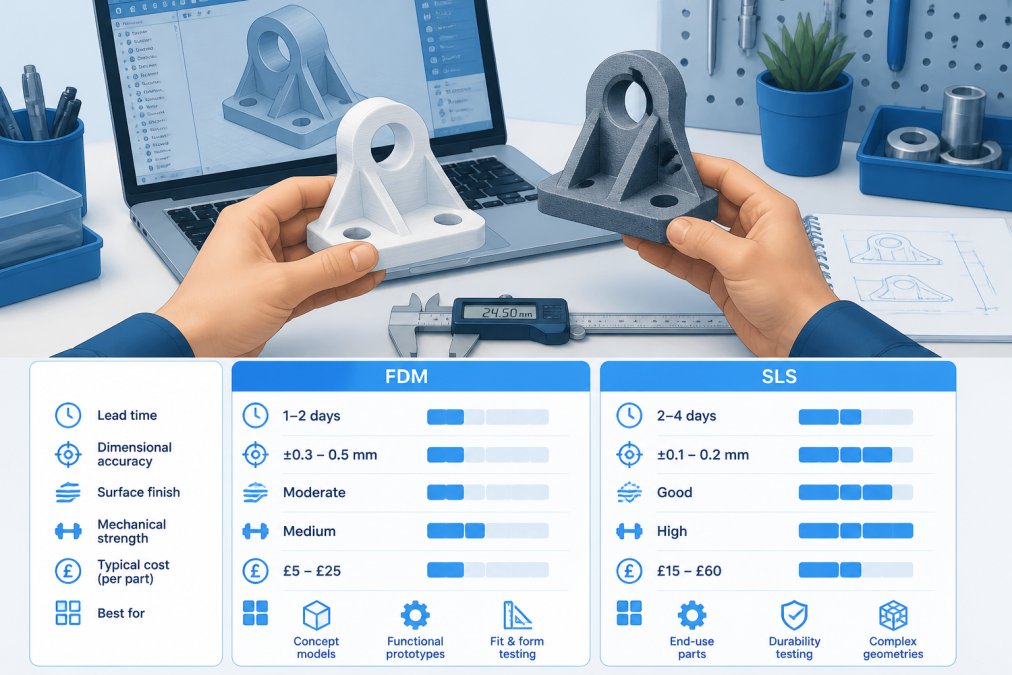
Each rapid prototyping method for product development trades surface finish, tolerance, material properties and unit cost against one another. The right choice is the one that answers your current question at the lowest cost, not the one with the best spec sheet.
Method | Typical Strength | Watch Out For | Best For |
|---|---|---|---|
FDM | Cheap, fast, tough plastics | Visible layer lines, weak in Z | Fit checks, jigs, brackets |
SLA | Fine detail, smooth surfaces | Brittle unless engineered resin | Form studies, small precision parts |
MJF | Repeatable, production-like nylon | Grainy finish as standard | End-use parts, enclosures, low volume |
Carbon DLS | Engineering-grade elastomers and rigid resins | Higher cost per part | Lattices, gaskets, wearables |
CNC | Tight tolerances, real alloys | Costly per unit at low volume | Metal interfaces, functional testing |
FDM is your first-pass method. It is the cheapest way to hold a design in your hand, and it is good enough to catch the mistakes that matter early: a boss in the wrong place, a wall too thin to assemble, a connector that fouls the housing. Do not use it for anything a customer will see.
SLA takes over when surface quality and fine features drive the decision. It is the method for form studies and small precision components, and it is the one most founders reach for when they need to show an investor something that looks finished.
MJF is the workhorse for anything approaching end use. It produces repeatable nylon parts with properties close to moulded components, which makes it the sensible bridge between a prototype and a small production run.
Carbon DLS earns its place when the part needs to behave like an elastomer. Lattice structures, gaskets, grips and wearable interfaces are where this technology outperforms everything else at low volume, because it produces engineering-grade materials with the consistency that functional testing demands.
CNC stays in the mix for metal. If your design has a threaded interface, a bearing seat or a load-bearing bracket, you need real aluminium or steel, and you need tolerances that printing cannot hold. Many startups run both: printed polymer housings around machined metal cores.
3D printing for product prototypes removes the constraints that tooling imposes. Undercuts, internal channels, lattice infill and consolidated assemblies all become possible, because there is no mould to open and no draft angle to respect.
The constraints that remain are worth knowing before you design around them. Minimum wall thickness, unsupported overhangs, anisotropic strength in layered parts, and the cost of post-processing all shape what is genuinely economical. A design that ignores these will print, and then fail.
What most guides miss is that design freedom is not the same as design sense. The best additive designs are usually simpler than their moulded equivalents, not more elaborate. Consolidating five parts into one is a genuine win. Adding internal geometry that nobody will ever inspect is not.
Small-batch manufacturing for start-ups is where additive manufacturing stops being a prototyping tool and becomes a production method. Runs in the hundreds to low thousands are where printed parts compete directly with tooling, and often win.
The arithmetic is straightforward. Tooling carries a fixed cost that must be absorbed by the whole run, so low volumes carry a punishing cost per unit. Additive has almost no fixed cost and a higher variable cost, which means it wins at low volume and loses as volume climbs. Somewhere in the middle there is a crossover point, and finding it is a commercial decision, not a technical one.
For a startup, that crossover is usually further out than founders expect. It is not uncommon for printed production to remain the sensible choice well past the point where a mould looks tempting, particularly when the design is still evolving or the product is configurable.
Prototype to production for start-ups is a documentation exercise, not a manufacturing one. The parts are usually ready long before the paperwork is, and the gap between the two is where quality problems breed.
Work through this before you place a production order:
That last point matters more than it looks. A production relationship fails most often not because parts are bad, but because a change was made without anyone recording it.
The most common mistake is prototyping without a question. Teams print twenty versions of a part because printing feels like progress, and finish the month with no clearer answer than they started with.
A second is optimising the wrong variable. Chasing a perfect surface finish on a part whose job is to prove an assembly sequence wastes both time and money. Match the fidelity of the prototype to the decision it informs.
A third is treating the first supplier relationship as transactional. Founders who brief their manufacturing partner properly, share the design intent and ask what will be difficult to make, get better parts. Those who send a file and wait for a quote get exactly what they asked for, including the problems they did not anticipate.
Choosing a rapid prototyping partner in Ely comes down to three things: whether they can hold your tolerances, whether they will tell you when your design is a problem, and whether they can scale with you.
Ask any prospective partner for a first-article inspection report on a similar part before you commit to a run. Ask who you will speak to when something goes wrong, and whether that person is the operator running your job or an account manager relaying messages. Ask what happens to your files and your digital inventory when the project pauses.
At 76 ADDITIVE, we work from Ely with startups and SMEs across the region and beyond, using MJF and Carbon DLS technology to produce repeatable end-use components without tooling investment. Direct communication with the operator running your job is standard, not a premium tier, and it is usually the difference between a part that works and a part that nearly works.
Hardware development punishes guesswork, and tooling punishes it hardest. The startups that get to market are the ones that iterate on printed parts until the design is genuinely settled, then commit to production with confidence.
If you are weighing up your next prototype or a low-volume production run, 76 ADDITIVE can quote from your CAD files, advise on the right method for your geometry, and produce repeatable parts without tooling investment. Get started with 76 ADDITIVE and turn your next revision around in days rather than months.
Rapid prototyping for startup hardware is the process of turning a CAD design into a physical part quickly, usually within days rather than weeks. Methods include FDM, SLA, MJF, Carbon DLS and CNC machining. The goal is to test fit, form and function before committing to expensive tooling. For start-ups, it means iterating through several design versions at low cost, then moving to small-batch production using the same additive process once the design is proven.
For runs of roughly 500 to 2,000 units, additive manufacturing often works out cheaper than injection moulding because there is no tooling investment. You pay per part rather than per mould, so a design change costs you a reprint rather than a new tool. The trade-off is unit price at very high volumes, where moulding still wins. For start-ups testing market demand, the flexibility usually outweighs the higher per-part cost.
Costs depend on part size, material, process and quantity, so there is no single figure. What drives the price is machine time and material volume, not tooling. This is why additive suits start-ups: you avoid the upfront tooling spend that traditional manufacturing requires. For an accurate figure on your specific parts, request a quote with your CAD files and expected volumes.
With additive processes, a prototype can be produced in days rather than the weeks or months traditional tooling takes. Lead time depends on part complexity, material availability and queue position at your provider. The bigger time saving comes from iteration: because there is no tool to cut, you can test a revised design, gather feedback and reprint without restarting the tooling process.
Move to production once the design has passed functional testing, tolerance checks and at least one round of user feedback. At that point, decide whether to scale with the same additive process or switch to moulding. For low and mid-size volumes, staying with additive keeps your options open and avoids tooling costs. If volumes climb into the tens of thousands, revisit the moulding comparison.
Industrial processes such as MJF and Carbon DLS are used for end-use components in demanding sectors, including aerospace and automotive. Tolerance capability depends on the specific process, material and part geometry. The practical step is to run a small test batch and measure the results against your drawing before committing to a larger order. Ask your provider for dimensional reports on the first run.
Order a small batch first, test it in the field, and only then scale. Additive manufacturing makes this straightforward because there is no tooling to write off if the design changes. Run the parts through the same tests your customers will, check repeatability across batches, and confirm the finish meets expectations. Once the design is locked, the same files can move into larger production runs.
Opening Hours (our printers run through the night)
Monday - Friday, 9am - 5pm


76 Additive
19 Hall Barn Road Industrial Estate
Isleham, Ely
Cambridgeshire, CB7 5RJ
76 Projects t/a 76 Additive
Registered in England & Wales Company no: 10235633
VAT: 245 830 796