Oct 12, 2026
Last Updated: 12 October 2026
Tooling is often the single biggest barrier between a good product idea and a profitable one. At 76 ADDITIVE in Ely, we've spent 17 years watching founders sink money into hard tooling before they've proved anyone wants the product, and it rarely ends well. The good news is that you can reduce tooling costs dramatically without cutting corners on quality. Below, we'll show you exactly how to rethink production, from design choices to manufacturing methods, so your money goes into the product rather than the mould.
The core argument here is simple: most tooling spend is a bet on volume you haven't sold yet. Shift that bet until the numbers justify it, and your cash stays in the business.
Hard tooling cost is not one number. It's a stack of costs, and most quotes only show you the top layer.
Tooling cost is the total expense of creating the moulds, dies, jigs and fixtures needed to manufacture a part at volume. For injection moulding, that usually means a steel or aluminium mould cut to your part's exact geometry.
The mould material sets your baseline. Hardened steel lasts longest but costs the most to buy and machine. Aluminium is cheaper and faster to cut, but wears sooner. Then there's the machining itself: complex geometry, tight tolerances and deep cavities all add hours to the process. Every extra hour is money.
A mould isn't finished when it's cut. Polishing, texturing, fitting and trialling all add labour. Each trial shot consumes material and machine time. If the part needs post-moulding finishing, that's another line on the quote. These costs are easy to miss because they arrive after you've already committed.
Injection moulding rewards volume and punishes complexity. The fastest way to reduce injection moulding costs is to simplify the part before the mould is ever cut.
Each of these removes machining hours from the mould. Fewer hours means a smaller bill. It also means fewer defects once production starts, which protects your margin long term.
The catch is that simplification has limits. Some geometries simply can't be moulded without expensive tooling features. That's when it pays to look at other methods.
3D printing for small batch production removes the mould entirely. That single change wipes out the largest line on a traditional tooling quote.
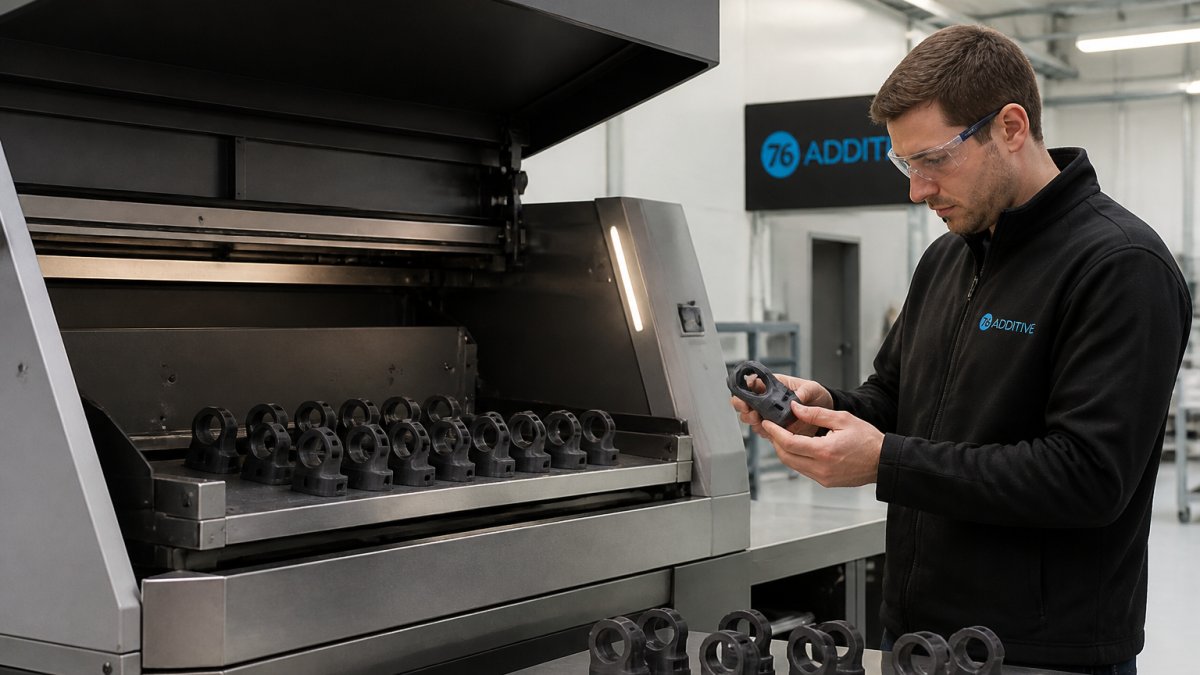
At 76 ADDITIVE, we use Multi Jet Fusion and Carbon DLS technology to produce end-use components without any tooling investment. You get repeatable parts, complex internal channels that moulding can't achieve, and a digital inventory you can reorder on demand. For cycling brands and product startups, that means you can iterate a design on Monday and hold a physical part days later.
The economics work best at low to mid volumes. Where moulding needs thousands of units to justify the tool, additive manufacturing lets you start with fifty and scale as demand proves itself.
Tooling cost versus unit cost is the trade-off that decides your method. Hard tooling front-loads cost: you pay a large sum once, then enjoy a low cost per part. Additive manufacturing flips it: no upfront tooling, but a higher cost per part.
So the question becomes volume. At low volumes, the tooling never pays for itself. At high volumes, the low unit cost wins. Somewhere between the two sits your break-even point.
Factor | Hard Tooling | 3D Printing |
|---|---|---|
Upfront cost | High | None |
Cost per part | Low | Higher |
Best volume | High | Low to mid |
Design changes | Costly | Easy |
Lead time | Weeks | Days |
The practical rule: if your volumes are still uncertain, don't buy the tool yet. Prove demand first, then invest when the numbers are certain.
Design for manufacturability is the practice of shaping a part so it's cheap and easy to make before any tooling is ordered. It's the highest-use step in the whole process, because a design decision costs nothing while a tooling change costs plenty.
Get the design right and you avoid rework entirely. Build in draft angles, standardise fasteners, and consolidate parts where you can. Talk to your manufacturer early, ideally at the concept stage, rather than after the design is frozen.
That early conversation is where a lot of money gets saved. Our team offers end-to-end design and development support, so problems surface on screen instead of in a mould.
Use this checklist before you commit to any tooling spend:
If you can't tick most of these, pause. The cheapest tooling decision is often the one you delay until the data supports it.
The real challenge isn't finding the cheapest quote, it's matching your method to your actual volume. Bet on tooling too early and you tie up cash you may never recover.
At 76 ADDITIVE, we help businesses across Ely and Cambridgeshire skip that risk entirely. Our Multi Jet Fusion and Carbon DLS printing needs no tooling investment, delivers repeatable end-use components, and gets you to market faster. If you're weighing up whether additive manufacturing fits your volumes, get in touch with our team for an instant quote.
Start-ups can avoid the high upfront investment of traditional tooling by using additive manufacturing for initial production runs. This approach eliminates the need for expensive moulds, allowing you to test the market and iterate on designs without financial risk. For low to mid-size volumes, 3D printing for small batch production offers a cost-effective alternative that scales with your business growth.
Tooling costs are the one-time expenses for creating the moulds or dies needed for production, which can be substantial. Unit costs are the recurring expenses for each individual part produced. Traditional manufacturing has high tooling and low unit costs, while additive manufacturing has no tooling costs and consistent unit costs regardless of volume, making it ideal for low-volume production.
Injection moulding becomes more cost-effective at very high production volumes, typically when you need hundreds of thousands of identical parts. The high initial tooling investment is spread across a massive number of units, lowering the cost per part. For low to mid-size volumes, the break-even point often favours additive manufacturing due to the absence of tooling costs.
Applying design for manufacturability principles can significantly reduce costs by simplifying the tooling required. This includes avoiding complex undercuts, maintaining uniform wall thickness, and designing parts that can be easily ejected from a mould. By simplifying the design, you reduce the complexity and cost of the mould itself, and can often avoid secondary machining operations.
Opening Hours (our printers run through the night)
Monday - Friday, 9am - 5pm


76 Additive
19 Hall Barn Road Industrial Estate
Isleham, Ely
Cambridgeshire, CB7 5RJ
76 Projects t/a 76 Additive
Registered in England & Wales Company no: 10235633
VAT: 245 830 796