Oct 16, 2026
Last Updated: 16 October 2026
To get a quote for 3D printing that you can actually act on, you need to send three things: a clean, watertight model file, a clear material and finish preference, and your target quantity and deadline. Everything else can be sorted out afterwards. At 76 ADDITIVE, we have spent 17 years in design and manufacturing, and we have seen the same pattern hold true across hundreds of enquiries: the briefs that come back with a firm price and a firm date are the ones that arrived complete.
A 3D printing quote is a written breakdown of what your part will cost to produce, covering machine time, material, finishing and any design support, along with the lead time to delivery. It is not just a number. It is a short technical conversation in written form.
So what happens after you hit send? Below, we walk through exactly how a quote is built, what we need from you to build it accurately, and the details that most often send a price back to the drawing board.
UK government guidance on manufacturing and additive processes
A complete quote request takes about fifteen minutes to prepare and saves days of back-and-forth. Most delays we see are not caused by complex geometry. They are caused by a missing wall thickness figure or an ambiguous note about "smooth finish".
Work through this before you send:
If you can supply all eight, your quote will normally come back the same working day.
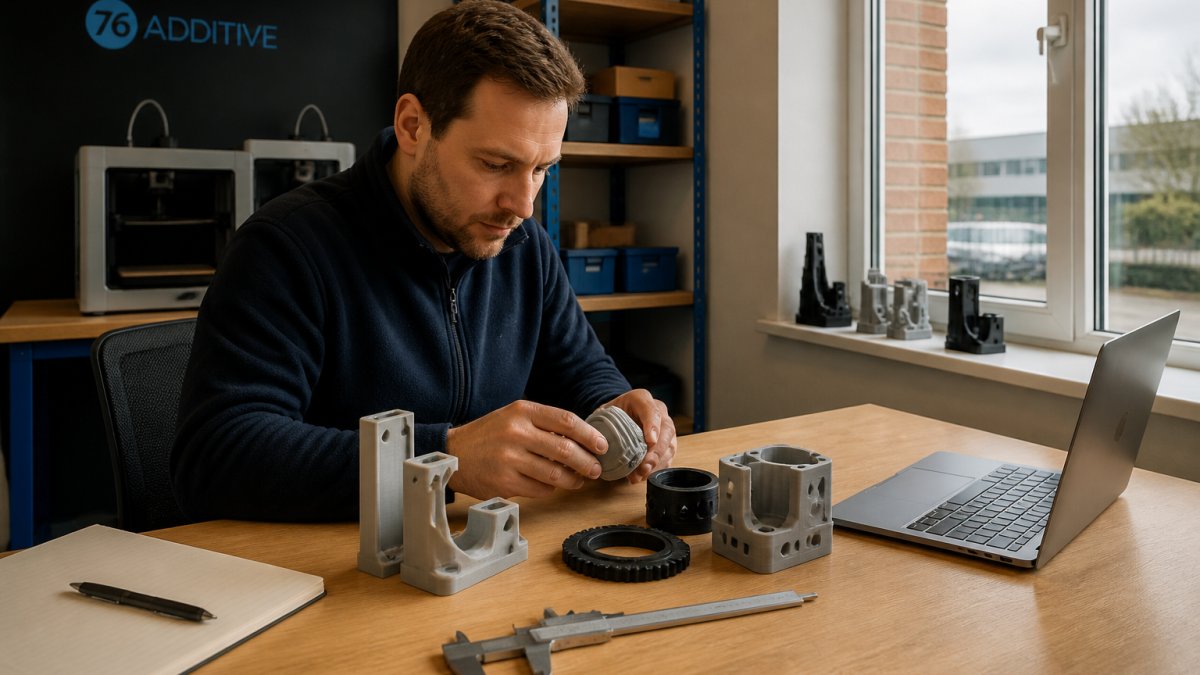
STL is a surface mesh format that carries geometry only, with no units, materials or colour information. STEP is a solid modelling format that preserves exact geometry and is the better choice when tolerances matter.
Here is the part most guides skip. Tolerance is not a single global setting. If you mark the whole part as ±0.1 mm, you will pay for precision in places that do not need it. Mark only the mating faces, bearing bores and sealing surfaces. Everything else can sit at the process default, and the price reflects that.
A common mistake is exporting an STL at the wrong scale. A part modelled in metres instead of millimetres arrives 1,000 times too large, and the first quote you get back will be meaningless.
Choosing a process before you choose a material is backwards. The application decides the material, and the material decides the process. Get that order right and the quote becomes straightforward.
For end-use components, we work mainly with two technologies at 76 ADDITIVE: Multi Jet Fusion (MJF) and Carbon Digital Light Synthesis (DLS). MJF builds tough nylon parts with good mechanical consistency across a full build bed, which suits brackets, housings and enclosures. Carbon DLS produces fine feature detail and smooth surfaces, which suits lattices, small precision parts and components where surface quality is visible to the customer.
The table below is the fastest way to narrow your options before you write your brief.
Requirement | MJF (nylon) | Carbon DLS (resin) |
|---|---|---|
Best for | Functional brackets, housings | Fine detail, lattices, small parts |
Surface as-built | Slightly grainy | Smooth |
Living hinges | Limited | Good |
Small features | Moderate | Very fine |
Typical use | End-use parts, test batches | Precision and cosmetic parts |
If your part has internal channels or geometry that traditional tooling cannot produce, say so in the brief. It changes which process we recommend, and it is exactly the kind of work additive manufacturing handles well.
Industrial 3D printing service pricing is driven by four variables: machine time, material volume, post-processing and quantity, in that rough order of impact. There is no meaningful "price per gram" figure that applies across the board, because a tall, thin part and a short, dense part of identical mass occupy very different amounts of build space.
This is why we ask for quantity up front. Unit cost falls as quantity rises, because the build preparation and machine setup are spread across more parts. A single prototype carries the full setup cost alone.
Be wary of any quote that arrives without a breakdown. A proper quote tells you what you are paying for.
Machine time is the largest single cost. It covers the hours your part occupies the build chamber, and it is fixed by geometry and build height rather than by how much material you use.
Material is the second. Powder-based processes use the material in the part plus a surrounding volume that supports it during the build, so a part with a large footprint costs more in material than its finished weight suggests.
Post-processing is where quotes diverge most. Support removal, bead blasting, dyeing, tumbling, painting and any machining of critical faces are separate operations, each with its own handling. If you need a specific finish, name it. If you do not, we will quote the as-built finish and you can add finishing later once you have seen the part.
3D printed part lead time typically runs from a few working days for a small batch of straightforward parts to a couple of weeks for larger runs or parts needing significant finishing. The clock starts when you approve the quote and the file is locked, not when you first send the enquiry.
The sequence is short and predictable:
Two things extend this: revisions after approval, and finishing requirements added late. If you think you may want a dyed or painted finish, tell us at quote stage. Adding it afterwards means the part re-enters the queue.
For teams in Ely, we can often compress the front end of that sequence because we can discuss the model directly with the person who designed it.
Send your request to a provider who will talk to you about the part, not just process the file. The difference shows up in the first reply. A useful response asks a question about function, tolerance or quantity. A less useful one returns a number with no context.
Three things to look for:
That last point matters more than most buyers expect. A test batch answers the question that a quote cannot: will this actually work for our part, at our tolerances, in our application?
If you are searching for a 3D printing quote near me in Ely or the surrounding area, the practical test is the same wherever the provider sits: send a complete brief and see how specific the reply is.
The gap between a quote that works and one that wastes a week is almost always in the brief. Send a clean file, name your material and finish, state your quantity and deadline, and mark only the tolerances that matter.
At 76 ADDITIVE, we build parts in MJF and Carbon DLS with no tooling investment, direct access to the operator running your build, and end-to-end design support when a model needs adjusting before it prints. We work with startups and SMEs moving from traditional manufacturing to on-demand production, including cycling brands and our own in-house projects at 76 Projects.
Send your files to 76 ADDITIVE and get a quote built on the details that actually decide the outcome.
Send a 3D model, the quantities you need, the material or performance requirements, and any tolerances or surface finish that matter to the part. Add the deadline you are working to and where the parts are going. If you cannot supply a model, a clear technical drawing with dimensions still gives enough to price the job. The more of this you provide up front, the fewer rounds of questions before a figure comes back.
STL and STEP files are the two most common formats. STL carries the shape only, so include a drawing or notes if tolerances matter. STEP keeps the solid model and dimensions, which suits parts that need to fit existing assemblies. Send one part per file and name each file clearly.
Material choice, part volume, build height, the amount of support needed and any post-processing all move the number. Small parts packed into a single build cost less per unit than a tall part that uses the full build chamber alone. Tighter tolerances, extra finishing and low volumes each add cost, while larger batches spread the setup across more parts. Industrial 3D printing service pricing reflects all of these, so a detailed request gets a more accurate figure.
A quote usually comes back within a working day or two when your files are complete, and questions about the model can add a short delay. Once approved, 3D printed part lead time depends on the process, material and queue, with many jobs running in days rather than the weeks traditional tooling takes. Ask for the expected dispatch date in writing so you can plan testing, assembly or a launch around it.
Opening Hours (our printers run through the night)
Monday - Friday, 9am - 5pm


76 Additive
19 Hall Barn Road Industrial Estate
Isleham, Ely
Cambridgeshire, CB7 5RJ
76 Projects t/a 76 Additive
Registered in England & Wales Company no: 10235633
VAT: 245 830 796