Oct 25, 2026
Last Updated: October 25, 2026
Quick Summary
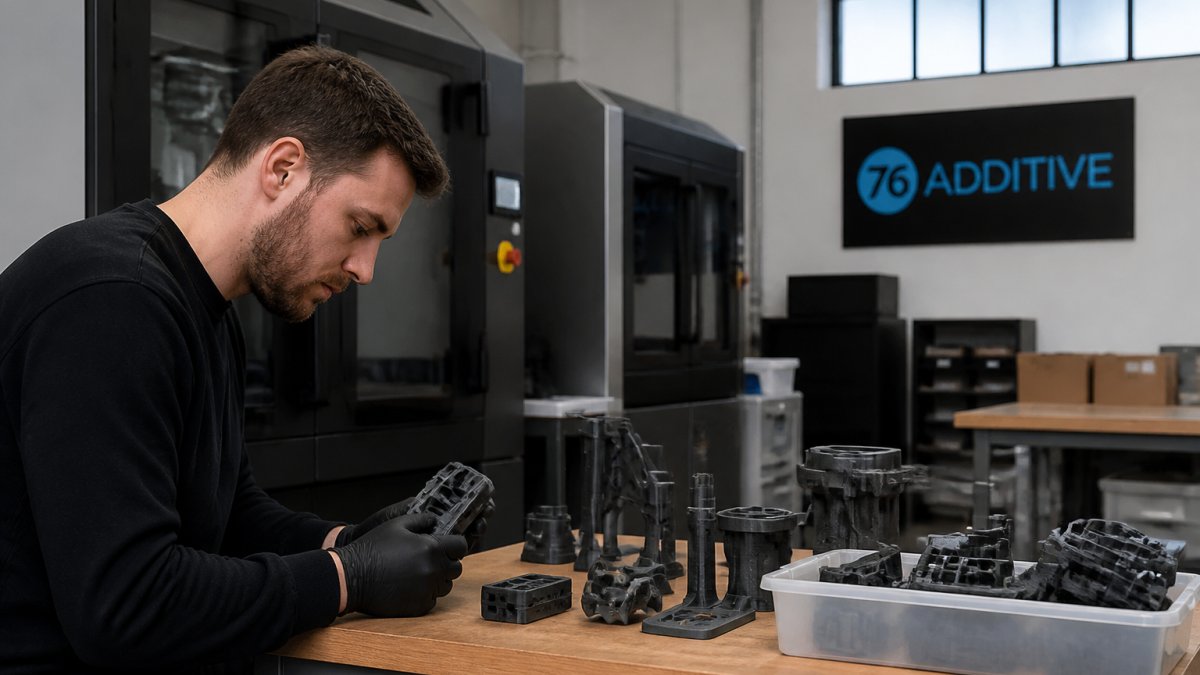
On-demand manufacturing makes parts only when ordered, directly from digital design files, with no physical tooling created in advance. This removes upfront mould costs, allows design changes by editing the file, and brings the first part in days rather than weeks.
The benefits of on-demand manufacturing start with a simple fact: you can hold a finished, end-use part in your hand without paying for a mould first. At 76 Additive in Ely, Cambridgeshire, we build production-grade components using Multi Jet Fusion and Carbon DLS, so there is no tooling investment sitting between your design file and a part you can test.
Traditional injection moulding punishes uncertainty. A steel tool represents a large fixed cost committed before you know whether the design works, and any change after that means paying again. A study published in Computers in Industry (2025) identifies low start-up costs, flexibility and on-time production among the core advantages of digitalised, on-demand production models (study on virtual warehousing and on-demand manufacturing).
That single shift, from paying upfront for a tool to paying per part, changes how a small team can plan. You iterate on the design, not on the tool.
On-demand manufacturing is a production model where parts are made only when ordered, directly from digital design files, with no physical tooling created in advance. The workflow is short and repeatable:
The absence of tooling is what makes repeat orders straightforward. Your digital file becomes the master record, so a second batch matches the first without a new setup. If you want to understand the technology behind that repeatability, our MJF 3D printing technology page explains how the process holds accuracy across runs.
The comparison comes down to where the money and the risk sit. Injection moulding puts cost and commitment at the front; on-demand additive manufacturing puts them at the point of each order.
Factor | Traditional Moulding | On-Demand Manufacturing |
|---|---|---|
Upfront tooling cost | High, paid before first part | None |
Design changes | New tool or rework | Edit the file, reprint |
Lead time to first part | Weeks to months | Days |
Economic volume | Thousands of units | Low to mid volumes |
Geometry freedom | Limited by mould release | Complex internal channels possible |
For a start-up weighing 500 to 2,000 units per run, the tooling decision is the whole argument. Additive wins when design uncertainty is high or volume is modest. If you want to see how quoting works before committing, our guide to the on-demand 3D printing quote process walks through it.
The benefits of additive manufacturing are easiest to see in three areas.
Design freedom. Internal channels, lattice structures and consolidated assemblies are all printable. Geometry that a mould cannot release becomes routine.
Speed to market. No tool means the first article arrives in days, so testing starts sooner and feedback loops shorten.
Digital inventory. You store a file, not a warehouse of parts, and print against demand. A common mistake is ordering a large first batch to chase a unit price; start smaller, validate the design, then scale.
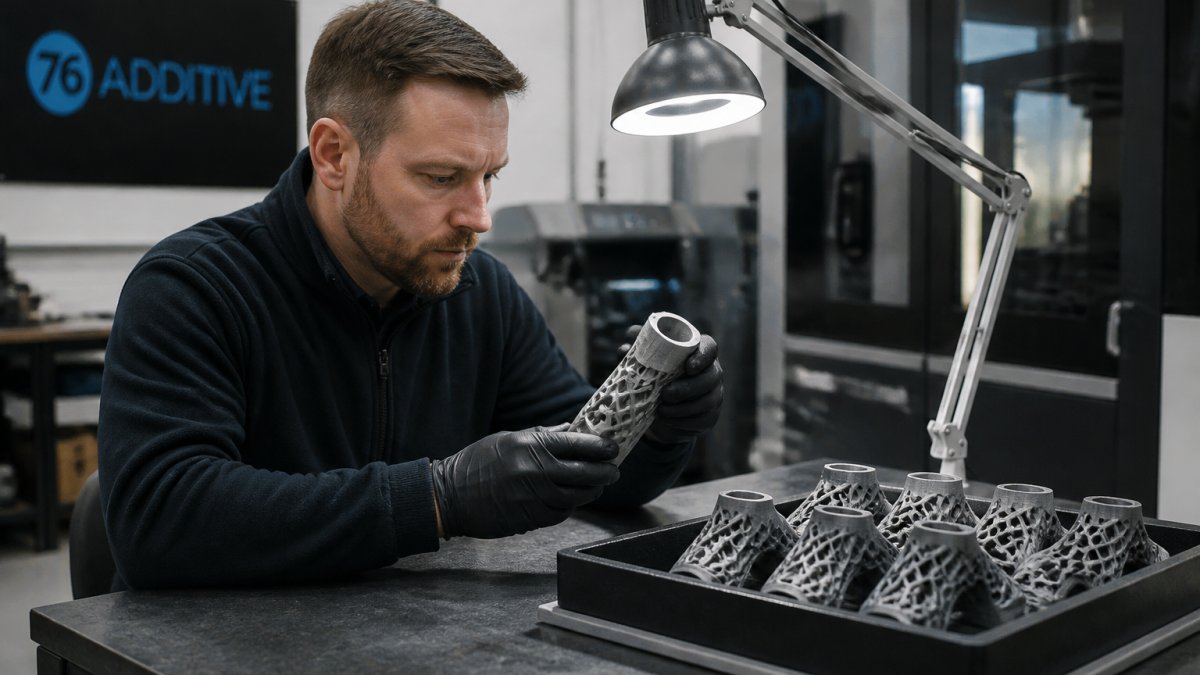
Real examples matter more than theory. We produce components for a number of UK cycling brands, where riders and designers need custom parts iterated quickly between test sessions. Our in-house brand, 76 Projects, runs on the same model: design, print, test, refine.
Drone developers use the same approach for brackets and housings, printing small batches to validate fit before committing to volume. You can browse our MJF case studies to see how these projects came together.
Additive is not the answer to every brief, and pretending otherwise does nobody favours. Unit costs stay higher than moulding at very high volumes, so the crossover point deserves an honest calculation. Surface finish differs from a polished tool, which matters for visible cosmetic parts.
Watch out: skipping a test batch before a large order is the mistake that costs most. Print a small run, check the tolerances, then scale. Consistency across batches is achievable, but it is verified, not assumed.
The benefits of on-demand manufacturing are real, and they compound when you work with a partner who builds production-grade parts rather than prototypes. We bring 17 years in design and manufacturing, direct communication with the operator running your build, and end-to-end design support from our base in Ely.
If you are ready to move from drawing to part, contact 76 Additive and tell us what you need to make. Get started with 76 Additive and put your first production-grade component into test this month.
The headline gains are no tooling investment, faster speed-to-market, and design freedom that traditional processes cannot match. You can also hold a digital inventory and print only what you need, which reduces stock risk. Research published in Computers in Industry in 2025 identified mass customisation, flexibility, on-time production and low start-up costs as core advantages. For UK SMEs, that means launching a product without committing to expensive moulds before you have proven demand.
For low and mid-size volumes, it often is, because you avoid the upfront tooling spend that only pays back at higher quantities. The on-demand manufacturing process prices each part rather than each mould, so small batches remain viable. At 500 to 2,000 units, the right answer depends on part geometry, material and how often you expect to revise the design. Ask for a quote with your volumes and compare the total spend against tooling plus minimum order quantities.
Industrial processes such as MJF and Carbon DLS are used for end-use components where repeatability matters, not just visual models. The practical step is to run a small test batch against your drawing tolerances before committing to a larger order. Share your critical dimensions and inspection requirements at quoting stage so the process and material are matched to them. A supplier used to production parts will tell you honestly where a feature needs redesigning.
Unit costs stay higher than high-volume injection moulding, so the economics favour low and mid-size runs. Material choice is narrower than the full plastics catalogue, and very large parts can be constrained by build volume. Surface finish differs from a polished mould tool and may need post-processing. None of these rule the process out; they simply mean you should match it to the right stage of the product, then plan a transition to tooling if volumes climb.
Opening Hours (our printers run through the night)
Monday - Friday, 9am - 5pm


76 Additive
19 Hall Barn Road Industrial Estate
Isleham, Ely
Cambridgeshire, CB7 5RJ
76 Projects t/a 76 Additive
Registered in England & Wales Company no: 10235633
VAT: 245 830 796