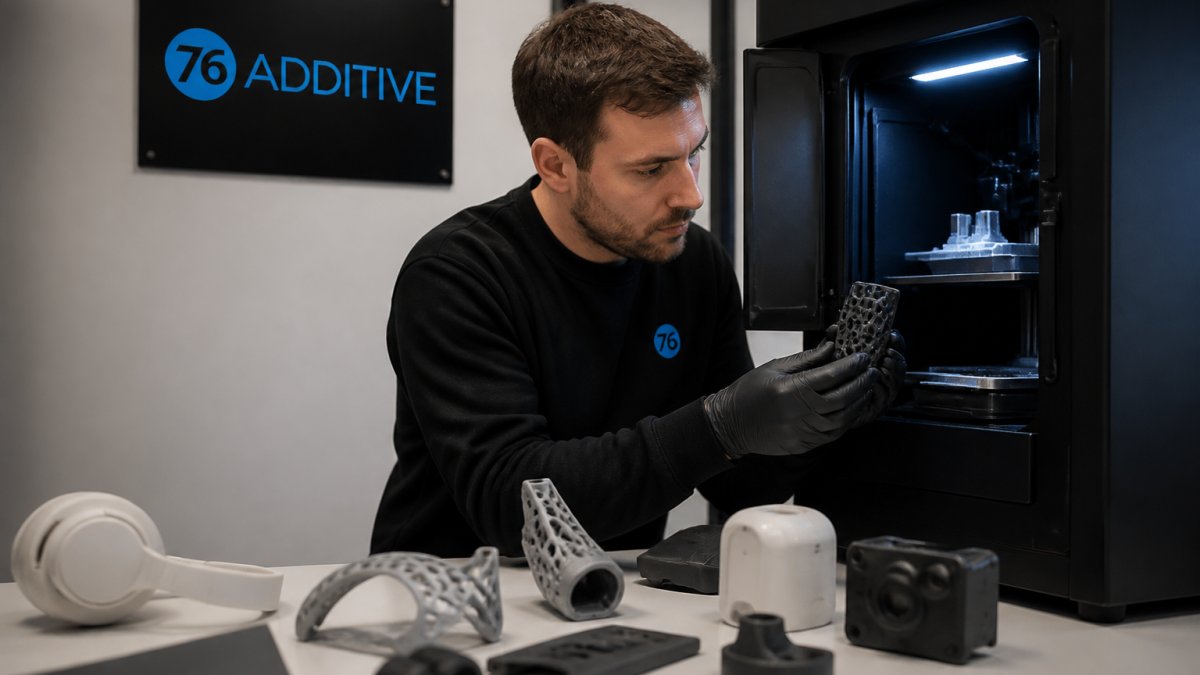
Oct 26, 2026
Last Updated: 26 October 2026
Quick Summary
Additive manufacturing suits consumer electronics at low and mid volumes, where the cost per part stays flat and no tooling spend is needed before your first sale. It is usually the better call for runs of 500 to 2,000 units, while moulding wins at very high volumes.
Additive manufacturing for consumer electronics is the production of end-use parts, usually enclosures and housings, by building them layer by layer instead of moulding them in a tool. It removes the biggest barrier in hardware: the cost of tooling before you have sold a single unit.
The numbers behind that shift are hard to ignore. According to additive manufacturing market data, nearly 37 million consumer-product parts were 3D printed in 2023, a 23% year-on-year increase. That is not prototyping volume. That is production.
At 76 ADDITIVE in Ely, Cambridgeshire, we build end-use components for exactly this kind of work. Three reasons make it fit low and mid-volume electronics:
Traditional injection moulding rewards scale. Below a few thousand units, the economics rarely work. Additive manufacturing flips that: the cost per part stays flat, so a run of 500 is viable.
3D-printed electronics enclosures are housings printed directly from a digital file, complete with mounting bosses, cable channels and internal ribs in a single piece. The design freedom is the point. You can build geometry that a two-part mould cannot release.
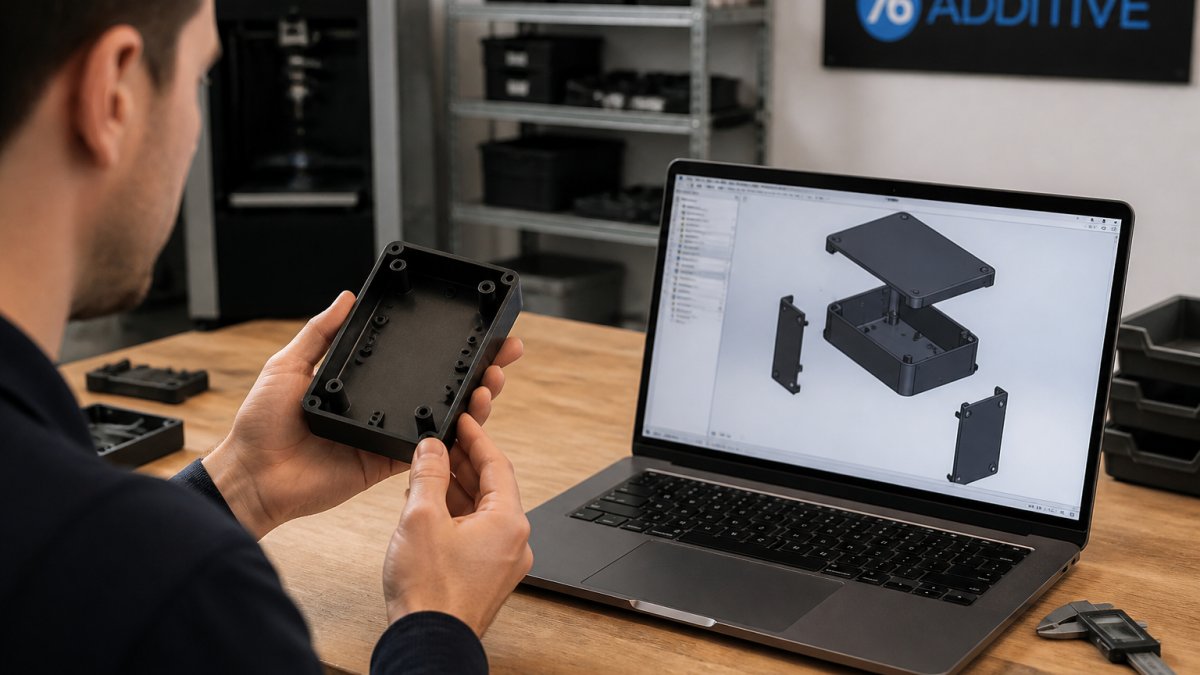
Practical parts we produce include:
What most guides miss is the finishing stage. A printed enclosure straight off the machine looks industrial. Dyeing, shot peening and Cerakote change that, giving a consumer product the colour and surface quality buyers expect. You can review the options on our finishing services page.
The right 3D printing material for electronics depends on three things: heat exposure, impact, and whether the part needs to flex. Get those wrong and a good design still fails in the field.
Nylon PA11 and PA12 are the workhorses here. PA12 is stiffer and holds tolerances well. PA11 is tougher and takes impact better, which matters for anything dropped or worn.
Material | Strength | Best For | Watch Out For |
|---|---|---|---|
Nylon PA12 | Stiff, accurate | Rigid enclosures, brackets | Less flex under load |
Nylon PA11 | Tough, impact-resistant | Wearables, handheld cases | Slightly softer surface |
Both run on our Multi Jet Fusion process, which produces consistent, repeatable parts. You can discover our Nylon PA11 and PA12 materials and see which suits your housing.
A common mistake is choosing material by data sheet alone. In practice, wall thickness and print orientation change performance more than the grade does.
Design for additive manufacturing electronics means designing to the process from the start, not adapting a moulded part afterwards. The rules are simple, and each one saves money.
The real difference between a cheap print and an expensive one comes down to orientation. A part rotated to minimise support material can cut finishing time sharply.
Watch out: designing internal channels with sharp corners traps powder and blocks cleaning. Radius every internal turn.
Rapid prototyping consumer electronics compresses the gap between design and a part in your hand. With no tool to cut, a revision is a file change, not a re-quote.
The global additive-manufacturing market was valued at USD 30.6 billion in 2025 and is projected to reach USD 37.6 billion in 2026, according to Grand View Research's market forecast. Speed is a large part of why.
Here is how we would run a first build:
That loop is why a startup can test three enclosure versions in the time a mould shop quotes one. For a deeper look, read our guide to custom plastic parts with fast turnaround.
Additive manufacturing is not the right answer for every product, and we will tell you when it is not. The evidence for its advantages is real but narrow.
Where it falls short:
If your run is 50,000 units, we will say so. If it is 500 to 2,000, additive is usually the better call.
Choosing a manufacturing route comes down to volume, tolerance and time. If you are weighing additive manufacturing for consumer electronics against tooling, the honest answer depends on your numbers, and we will give you a straight one.
We have 17 years in design and manufacturing, and we produce components for many UK cycling brands. Our in-house MJF and Carbon DLS machines handle prototypes and repeat production runs.
You can discover our in-house 3D printing services, or contact us to talk through your part. If you are searching for additive manufacturing near me in Cambridgeshire, our Ely workshop is the place to start.
Yes. Additive manufacturing produces enclosures with integrated bosses, snap-fits, and cable routing that injection moulding cannot achieve without extra tooling. Materials such as PA12 and flame-retardant nylon handle the heat and mechanical loads typical of consumer devices. 76 ADDITIVE uses MJF and Carbon DLS processes to deliver repeatable enclosures for low and mid-volume runs, so you can test fit and function before committing to hard tooling.
The choice depends on the job. Nylon PA12 suits structural housings and handles impact well. Flame-retardant grades meet safety expectations for powered devices. TPU works for seals and grips, while engineering resins from Carbon DLS give fine surface finish for visible parts. For 3D printing materials for electronics, check heat deflection temperature and dielectric properties against your operating conditions, then confirm with a test batch.
For low and mid-size volumes, additive manufacturing often beats injection moulding on total cost because there is no tooling investment. At 500 to 2,000 units, the savings on moulds and design revisions usually outweigh the higher per-part price. Pricing depends on quantity, material, and finishing, so request a quote from 76 ADDITIVE with your CAD files and volume to see the comparison for your specific part.
They can. Nearly 37 million consumer-product parts were 3D printed in 2023, a 23% year-on-year increase, according to VoxelMatters. End-use production now covers audio equipment and electronic devices. The key is consistency: ask your supplier how they control batch-to-batch quality. 76 ADDITIVE produces end-use components for UK cycling brands, which shows the process holds up outside prototyping.
Ready to test whether additive fits your product? Get started with 76 ADDITIVE and turn your next enclosure revision into a printed part this week.
Opening Hours (our printers run through the night)
Monday - Friday, 9am - 5pm


76 Additive
19 Hall Barn Road Industrial Estate
Isleham, Ely
Cambridgeshire, CB7 5RJ
76 Projects t/a 76 Additive
Registered in England & Wales Company no: 10235633
VAT: 245 830 796