Oct 05, 2026
Last Updated: 5 October 2026
Rapid prototyping for aerospace components is the practice of producing functional, testable parts directly from digital designs without hard tooling, letting engineering teams iterate on geometry, materials and fit before committing to production. At 76 ADDITIVE in Ely, we have spent 17 years in design and manufacturing watching that shift happen, and the reason is straightforward: aerospace tolerances are unforgiving, and a design flaw found after tooling is cut is expensive to fix. A bracket that weighs 40 grams too much, or a duct that will not clear its neighbour, costs weeks to correct once a mould exists. Additive processes remove that risk from the early stages. Below, we break down the methods, the materials, the testing regimes and the point at which tooling genuinely wins.
Aerospace teams generally choose between Multi Jet Fusion (MJF), Carbon Digital Light Synthesis (DLS) and Fused Deposition Modelling (FDM), with the choice driven by feature resolution, isotropy and surface finish rather than raw speed. MJF suits strong brackets and ducting where consistent mechanical properties matter. DLS produces smoother, more isotropic parts for fine features and elastomeric geometries. FDM remains useful for jigs and fit-check fixtures where cost dominates.
Method | Typical Strength | Best For | Main Limitation |
|---|---|---|---|
MJF | Strong, near-isotropic | Brackets, ducting, enclosures | Visible surface texture |
DLS | Smooth, isotropic | Fine features, elastomers | Higher unit cost |
FDM | Adequate for fixtures | Jigs, fit checks | Layer lines, weaker Z-axis |
Aerospace 3D printing is excellent at complex internal channels, consolidated assemblies and low-volume production, but it is not a universal replacement for machined or cast parts. Where a component faces sustained high temperature or extreme fatigue loading, traditional processes still hold the advantage.
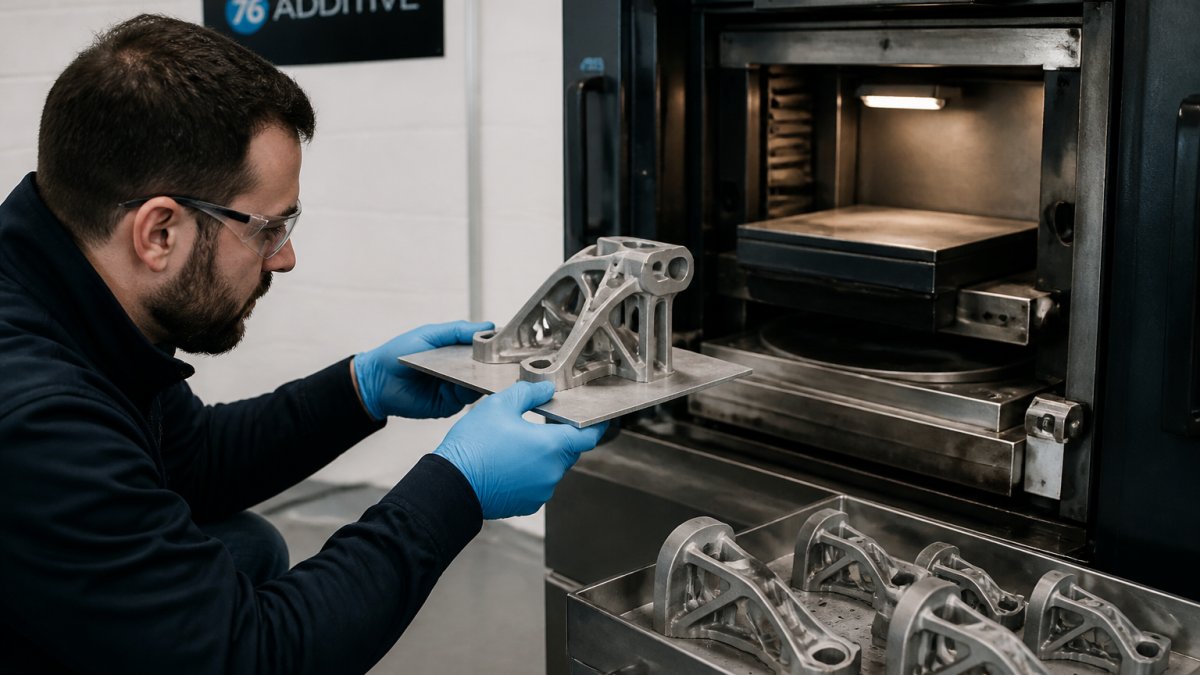
What it does well: conformal cooling channels, weight-optimised lattices, and parts that would otherwise require five components bolted together. What it cannot do: match the grain structure of a forged aluminium component, or hit the tightest tolerances on a bearing surface without post-machining. Teams that understand this boundary get the most from additive.
Material selection for rapid prototyping materials for aerospace hinges on three questions: what temperature the part sees, what load it carries, and whether it needs flame, smoke and toxicity compliance. Common choices include glass-filled nylon for structural brackets, flame-retardant nylon for cabin interior parts, and rigid or elastomeric resins for seals and ducts. The right answer depends on the application, not on what is cheapest per kilogram. For cabin components, FST performance governs the decision. For engine-adjacent parts, temperature resistance dominates. We advise teams to define the service environment before choosing a material, because switching later invalidates test results.
Aerospace prototype testing moves through dimensional verification, bench testing and, where required, formal qualification. Dimensional checks confirm the part matches the CAD model within tolerance. Bench testing applies representative loads, vibration and thermal cycling. Only after these stages does a part progress toward flight approval.
AS9100 is the quality management standard governing aerospace part production and testing, and prototypes intended for flight must be produced under a system that meets it. This means documented material traceability, controlled processes, and recorded inspection results. For teams new to additive, the practical implication is that your supplier's quality system matters as much as the printer. Ask for material certificates, build records and inspection reports before committing to a production run. If you are searching for a rapid prototyping partner near me, the quality documentation should be the first thing you review, not the last.
Additive wins below the volume where tooling amortisation pays back, and loses above it. For runs in the hundreds to low thousands, eliminating tooling cost and lead time usually outweighs the higher per-part price. Above that, injection moulding or casting typically becomes cheaper per unit. The crossover depends on part complexity, material and tooling cost, so it must be calculated per component rather than assumed. At 76 ADDITIVE, our MJF and Carbon DLS systems carry no tooling investment, which makes them well suited to low and mid-size volume production and to bridge manufacturing while tooling is prepared.
The challenge for most aerospace programmes is not choosing additive or traditional manufacturing, but knowing where each applies. Get that boundary right and you cut both risk and lead time.
At 76 ADDITIVE, we support that decision with state-of-the-art MJF and Carbon DLS printing, no tooling investment, direct communication with the operator running your parts, and end-to-end design and development support. Our Ely facility produces high-quality, repeatable end-use components for teams that need to move quickly without compromising on quality. Get started with 76 ADDITIVE and take your next prototype from design to tested part faster.
Rapid prototyping lets aerospace teams build and test physical components before committing to expensive tooling. Engineers use it to validate fit, form and function, catch design errors early, and iterate quickly on brackets, ducts and housings. Because no hard tooling is needed, a revised design can be printed and tested within days rather than months. This shortens development cycles and reduces the cost of late-stage changes.
Multi Jet Fusion (MJF) and Carbon Digital Light Synthesis (DLS) are common choices for functional aerospace prototypes. MJF suits strong, dimensionally stable parts such as brackets and enclosures, while DLS produces smooth, isotropic components with fine feature detail for complex geometries. Both avoid tooling investment, so low and mid-volume runs stay economical. The right process depends on your part's load path, surface finish and tolerance requirements.
Rapid prototyping materials for aerospace need to balance strength, heat resistance and weight. Engineering-grade nylons reinforced with glass or carbon fibre are widely used for structural brackets and housings, while high-temperature resins suit parts near engines or avionics. Material choice should match the test regime: a fit-check prototype may only need dimensional accuracy, whereas a vibration or thermal test demands a material that behaves like the final production part.
Prototypes intended for flight or safety-critical use should be produced under AS9100-aligned processes, which cover traceability, material certification and inspection records. Even early prototypes benefit from documented dimensional checks against the CAD model. AS9100 standards for part testing ensure that every batch can be traced back to its material lot and machine, which matters when you scale from prototype to low-volume production and need to demonstrate consistency to a customer or regulator.
Opening Hours (our printers run through the night)
Monday - Friday, 9am - 5pm


76 Additive
19 Hall Barn Road Industrial Estate
Isleham, Ely
Cambridgeshire, CB7 5RJ
76 Projects t/a 76 Additive
Registered in England & Wales Company no: 10235633
VAT: 245 830 796