Oct 04, 2026
Last Updated: 4 October 2026
Industrial 3D printing service pricing is the total cost a manufacturer charges to produce a part additively, built up from material, machine time and labour rather than a single flat rate. At 76 ADDITIVE, we quote every job on those three cost centres, because they are the only ones that move the number. A 3D printing quote is not a price list. It is an estimate of how much material your geometry consumes, how long it occupies a machine, and how much skilled handling it needs before it ships.
Three factors decide almost everything:
Change any one and the quote changes. That is why two similar-looking parts can differ sharply in price.
UK Health and Safety Executive guidance on additive manufacturing
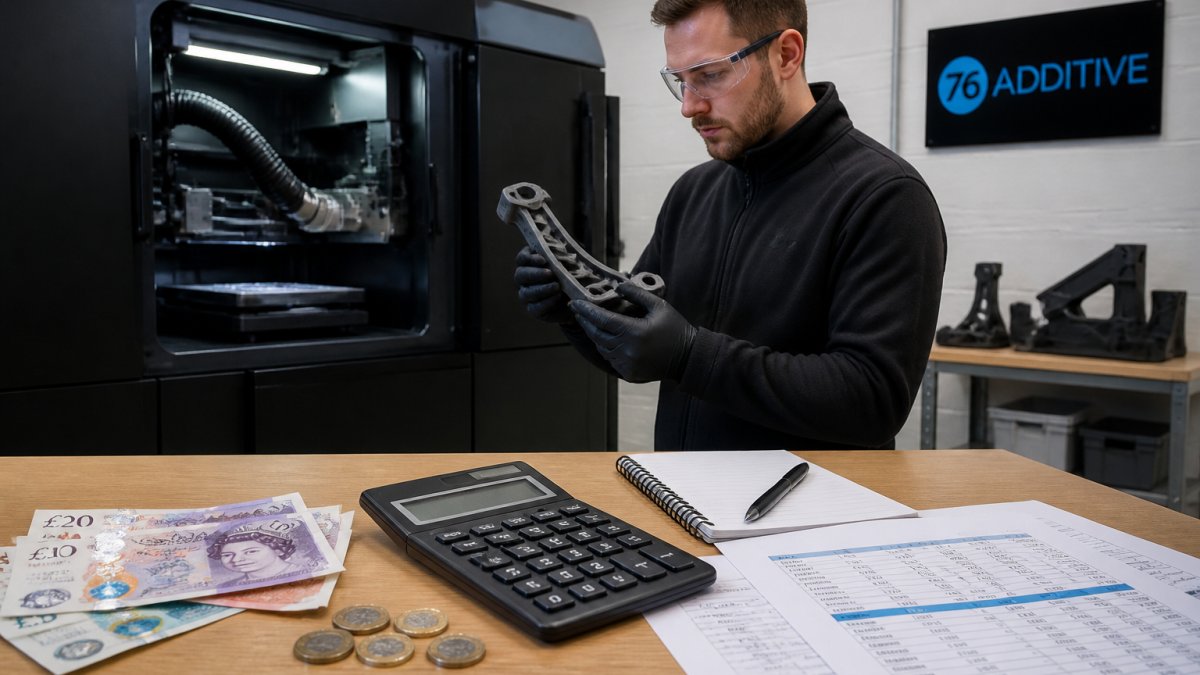
A 3D printing quote should itemise material, machine time, labour and any post-processing as separate lines, not bury them in one figure. If a supplier hands you a single number with no breakdown, you cannot tell whether you are paying for powder, print hours or hand-finishing. Ask for the split.
What a proper line-by-line quote shows:
Line item | What it covers | What to check |
|---|---|---|
Material | Powder, resin or filament consumed | Whether waste and support material are included |
Machine time | Hours on the printer | Build orientation and nesting efficiency |
Labour | Setup, removal, inspection | Whether inspection is quoted separately |
Post-processing | Dyeing, smoothing, machining | If tolerances need secondary work |
Aerospace and automotive buyers should ask about batch consistency specifically. A supplier who cannot explain how they hold tolerances across runs is a risk on any safety-relevant part.
Cost per part falls as volume rises, but not forever. The first unit carries the full setup, orientation and programming cost. The hundredth unit carries almost none of it, because the machine is already configured and the build is nested efficiently.
This is the part most guides miss. Additive manufacturing does not have a tooling cost to amortise, so the curve is gentler than injection moulding's. It also means there is no cliff edge where the thousandth part suddenly becomes cheap. The saving comes from spreading fixed setup across more units and filling the build volume.
For runs of roughly 500 to 2,000 units, additive is often competitive once you account for the tooling you never pay for. Below that, it can be a strong option. Above it, traditional processes start to close the gap.
SLS 3D printing cost is driven by powder volume and build packing more than by part count. Selective laser sintering fuses nylon powder layer by layer, so parts can be stacked in three dimensions without support structures. That packing efficiency is a key factor in price.
The break-even point between 3D printing and traditional manufacturing cost sits where tooling savings stop outweighing the higher per-part cost of additive. Injection moulding needs a mould, and that mould is a fixed cost you pay before a single part is made. Additive has no mould.
So the comparison is simple in principle:
Complex internal channels tip the balance toward additive at higher volumes than usual, because traditional processes may not be able to make the geometry at all. When a design cannot be moulded, the break-even argument is moot.
Cost comes down when you change the design and the build, not the quality. The biggest savings come from decisions made before the file ever reaches a printer.
Practical ways to cut cost:
Most inflated bills trace back to a handful of avoidable errors. None of them require cutting quality to fix.
The fix is not to haggle. It is to brief properly and quote at realistic volumes.
Getting industrial 3D printing service pricing right comes down to understanding what you are actually paying for: material, machine time and labour, quoted transparently and at the volumes you genuinely need. Most inflated bills are briefing failures, not pricing failures. 76 ADDITIVE has spent 17 years in design and manufacturing, and we quote every job line by line with direct access to the operator running your parts. Our MJF and Carbon DLS technology needs no tooling investment, which keeps low and mid-size runs economical and lets you scale without a mould. Get started with 76 ADDITIVE and request an instant quote for your next production run.
There is no single figure. Pricing depends on part size, material, process (MJF, SLS, DLS), quantity and finishing. Small brackets in nylon might cost a few pounds each at volume; large, complex aerospace components cost significantly more. Your best route is to request a 3D printing quote with your CAD file and required quantity. 76 Additive provides instant quotes so you can see the real number for your geometry.
Most services build the price from three elements: material volume, machine time and labour. Material is charged per cubic centimetre of powder or resin used. Machine time covers how long your part occupies the printer, which depends on build height and nesting efficiency. Labour includes post-processing like bead blasting, dyeing or support removal. Some providers add setup fees for new materials or rush jobs. Ask for a breakdown so you can see where your money goes.
It depends on volume and complexity. For low to mid-size runs (roughly 500 to 2,000 units), additive manufacturing usually wins because there is no tooling investment. Injection moulding becomes cheaper per part once you exceed the break-even point, which for a typical component might be several thousand units. Complex geometries with internal channels often stay cheaper with 3D printing at any volume because traditional methods cannot produce them without multiple assembly steps.
Nest multiple parts into one build to spread machine time. Choose a standard material like PA12 nylon rather than a speciality blend. Reduce support structures by orienting your part cleverly. Accept a longer lead time if you can, as rush jobs carry surcharges. Simplify non-critical features that add build height. Finally, share your full production forecast with your provider: committing to a larger batch often lowers the 3D printing cost per part.
Opening Hours (our printers run through the night)
Monday - Friday, 9am - 5pm


76 Additive
19 Hall Barn Road Industrial Estate
Isleham, Ely
Cambridgeshire, CB7 5RJ
76 Projects t/a 76 Additive
Registered in England & Wales Company no: 10235633
VAT: 245 830 796