Oct 14, 2026
Last Updated: October 14, 2026
Most quality failures start long before the printer does. They start with a drawing that never said what "good" means.
If you want to guarantee 3D printed part quality, you have to define it first. That means writing down tolerances and material specs before a single layer goes down. A tolerance is the acceptable range of variation for a dimension. If a bore should be 10.00 mm, a tolerance of ±0.20 mm tells everyone what will pass and what will not.
Here is how we would set this up:
A common mistake is copying tolerances from an old machined drawing. Additive processes behave differently. A slot that machines cleanly may need a wider tolerance when printed, because heat and layer direction both move the final size.
Get this stage right and everything downstream gets easier.
A quality control plan is a written set of checks, done at fixed points, by named people, with a pass or fail result recorded each time. Without one, you are inspecting from memory. That works until it doesn't.
At 76 Additive, we treat the QC plan as part of the job, not an afterthought. Here is what a workable plan looks like for a typical run.
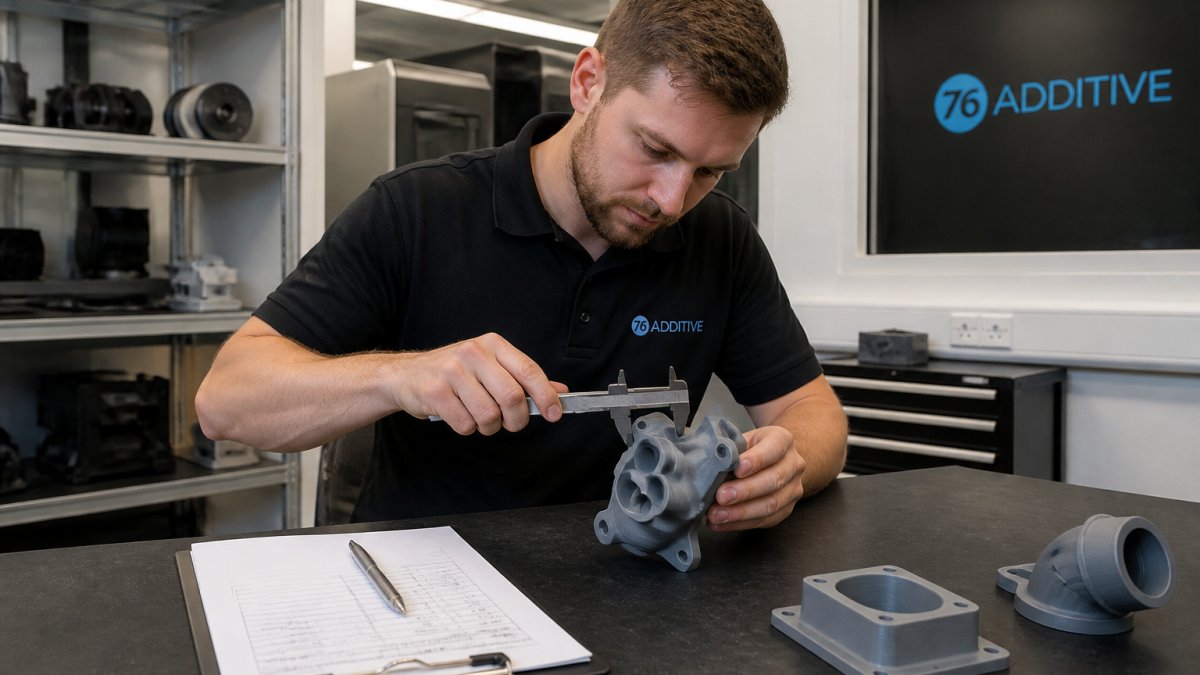
Every plan needs the same core elements:
The first-article inspection matters most. If part one is wrong, part two hundred will be wrong in the same way.
Write the plan once, then reuse it. Consistency is what makes 3D printed part quality control repeatable rather than lucky.
Testing proves the part works, not just that it measures correctly. A part can hit every dimension and still crack under load.
For fit, you check dimensions and assembly. For strength, you check how the part behaves under force. Both matter for end-use components.
Split your testing into two groups.
Non-destructive checks leave the part usable:
Destructive checks break or stress the part on purpose:
You cannot test every part to destruction. Instead, test samples from each batch and keep the results on file. That gives you evidence the process is stable without destroying your stock.
For cycling brands and sports equipment work, this is where real confidence comes from. A bracket that survives a lab test tells you far more than a drawing ever will.
Repeatability is the hardest part of the whole process. Anyone can print one good part. Printing the same good part next month is the real test.
Repeatable 3D printing depends on locking down the variables that change between runs:
Change one of these and your results drift. This is why digital records matter. If batch 12 fails and batch 11 passed, the records tell you what moved.
Stage | Check | Frequency | Owner |
|---|---|---|---|
Material intake | Batch and storage | Every delivery | Stores |
First article | Full dimensional | Every run | QC |
In-process | Spot dimensions | Set intervals | Operator |
Final | Critical features | Every batch | QC |
Sample test | Load and fit | Per batch | Engineering |
The table above is the backbone of a stable process. Fill it in for your own parts and stick to it.
The same faults show up again and again. Here are the ones we see most.
Most of these are process problems, not machine problems. The printer is rarely the weak link. The gap is usually in the plan around it.
Choosing the right partner removes most of the risk before it starts. We have spent 17 years in design and manufacturing, and we build quality into every stage rather than inspecting it in at the end.
Here is what that means in practice:
We produce components for many UK cycling brands, and we run our own in-house brand, 76 Projects. That means we sit on both sides of the table. We know what it is like to need parts that fit and last.
If you are near Ely in Cambridgeshire and want a manufacturing partner who can scale with you, we are set up for exactly that. Our team can run a small test batch first, so you can see the results on your own geometry before committing to a larger order. Just clear answers on what you are paying for.
Ready to see it for yourself? Get in touch with our team and tell us what you need to build.
Guaranteed 3D printed part quality is not about hoping each build turns out well. It comes from defined tolerances, a written QC plan, real testing, and a process you repeat the same way every time. Get those four things right and consistency stops being a gamble.
If you would rather not build that system from scratch, that is where we come in. 76 Additive offers MJF and Carbon DLS printing, end-to-end design support, and direct access to the operators running your parts. Whether you are in Ely or anywhere across the UK, we can help you move from prototype to repeatable production.
Get started with 76 Additive and build parts you can trust, batch after batch.
Start with dimensional checks using calibrated callipers or a coordinate measuring machine (CMM) against your CAD model. Then inspect surface finish, layer adhesion and internal features. For functional parts, add mechanical testing such as tensile or compression tests. A documented 3D printed part quality control plan should list every check, the equipment used and the pass/fail criteria so results are repeatable across batches.
Material choice, build orientation, layer thickness, temperature control and post-processing all influence final quality. Inconsistent powder or resin, worn nozzles and poor support removal also cause defects. The biggest factor is process discipline: locked print parameters, calibrated machines and documented procedures. Working with a partner like 76 Additive, which uses MJF and Carbon DLS technology, removes much of this variability because the process is controlled end to end.
Repeatable 3D printing depends on three things: fixed process parameters, regular machine calibration and batch-level inspection. Never change print settings between runs without re-validating. Keep a reference part from each batch and compare critical dimensions. If you outsource, ask your supplier how they control batch-to-batch variation. 76 Additive produces components for UK cycling brands where consistency across runs is essential, so they can explain their approach before you commit to a larger order.
Your plan should include: the part number and revision, material and supplier, print parameters, dimensional tolerances with measurement methods, surface finish requirements, mechanical test criteria, sampling frequency, and the person responsible for sign-off. Add a section for non-conformance handling so you know what happens when a part fails. This document becomes your proof of quality if a customer questions a batch, and it is the first thing a serious manufacturing partner will ask to see.
Opening Hours (our printers run through the night)
Monday - Friday, 9am - 5pm


76 Additive
19 Hall Barn Road Industrial Estate
Isleham, Ely
Cambridgeshire, CB7 5RJ
76 Projects t/a 76 Additive
Registered in England & Wales Company no: 10235633
VAT: 245 830 796