Oct 19, 2026
Last Updated: 18 October 2026
Cost effective production is the practice of getting a physical product made at a unit cost that leaves room for profit, without spending heavily on tooling before you know the design works. For most hardware startups, the gap between a working prototype and a sellable product is where budgets die. This guide from 76 ADDITIVE, based in Ely, Cambridgeshire, sets out how to close that gap.
The reason is simple. Traditional manufacturing rewards volume. Injection moulding, for example, spreads a large upfront tooling cost across thousands of parts. Order 300 and each part carries a heavy share of that tooling. Order 300,000 and the tooling cost almost disappears.
Startups rarely have 300,000 units of demand. They have an idea, a handful of prototypes, and a launch date.
So the question is not "what is the cheapest way to make this?" It is "what is the cheapest way to make this at the volume we can actually sell?" Those are different questions, and confusing them is the most common and most expensive mistake we see.
Below, we break down each production route, what it costs you in practice, and how to move from prototype to production without betting the company on a mould.
Rapid prototyping is the fastest way to find out whether a design works before committing money to tooling. A prototype that costs little and arrives in days tells you more than a business plan ever will.
The logic is straightforward. Every design change made after tooling is cut costs far more than the same change made in a prototype. So you want to fail early, fail cheaply, and fail often.
What that looks like in practice:
A common mistake is testing a prototype that is too polished. If you have spent weeks making it look like a finished product, you will resist changing it. Rough prototypes invite honest feedback.
3D printing for start-ups removes the tooling barrier entirely. There is no mould to cut, so the cost of making one part and the cost of making five hundred start from the same place.
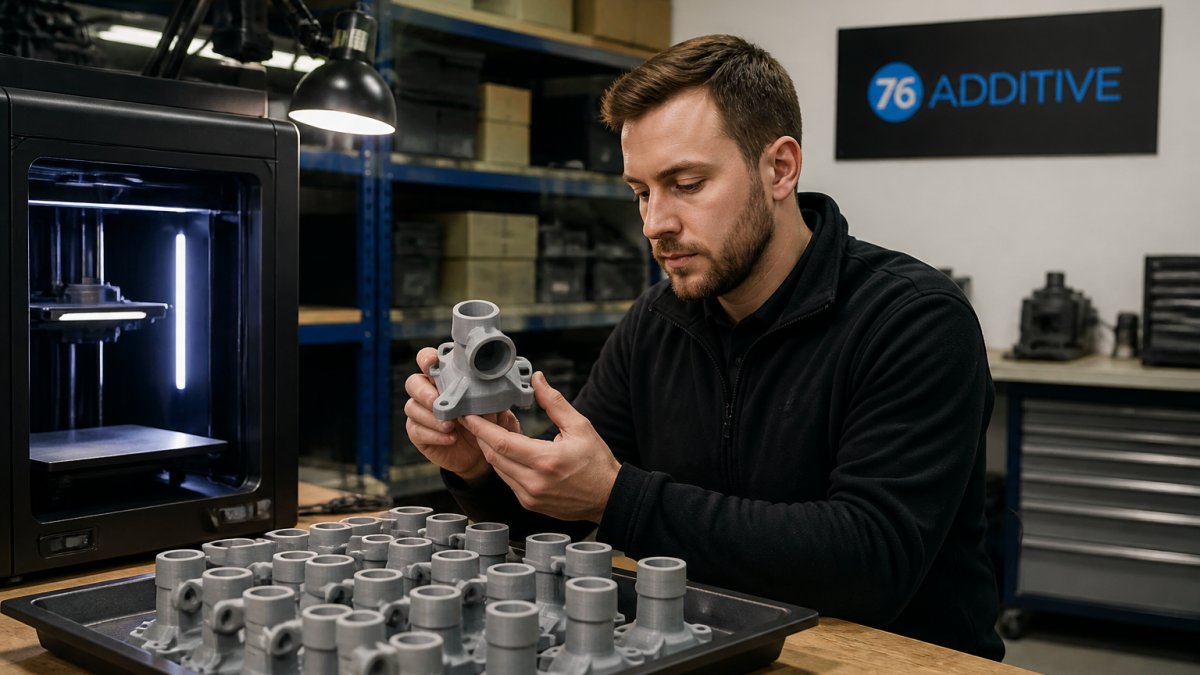
That changes the maths. With traditional tooling, low volumes carry a heavy penalty. With additive manufacturing, low volumes are the natural starting point.
What it does well:
Where it falls short:
We use Multi Jet Fusion and Carbon DLS processes at 76 ADDITIVE. Both are suited to end-use components, not just prototypes, which matters when you need parts that hold up in the field rather than on a shelf.
If you are unsure whether your geometry suits the process, our team can run a small test batch first. That is the honest way to find out before you commit to a larger order. You can contact us to discuss a trial run.
The prototype to production process is a staged route from a tested design to repeatable parts, where each stage answers a question before the next one spends money. Skip a stage and you carry the risk forward.
Here is how we would run it:
Expected result: a design you trust, a process you have tested, and a unit cost you can quote with confidence.
The step most teams rush is the pilot batch. It is also the one that catches quality drift before it reaches customers.
Small-batch manufacturing in the UK comes down to one rule: match the method to the volume, not to the method you wish you could afford. The right process at 500 units is often the wrong one at 50,000.
Volume band | Sensible route | Why it fits |
|---|---|---|
1-50 units | 3D printing | No tooling, fast turnaround |
50-2,000 units | Additive manufacturing | No tooling penalty, repeatable parts |
2,000-10,000 units | Bridge production, then review | Tooling starts to make sense |
10,000+ units | Moulding | Tooling cost spreads thin |
The trap is jumping to the bottom row too early. A startup with 800 units of real demand does not need a mould. It needs parts.
For founders near Ely and across Cambridgeshire, working with a local additive manufacturing partner shortens the feedback loop. You can visit, see the process, and talk to the operator directly. That direct line matters more than most people expect when a design needs a tweak mid-run.
Material choice drives unit cost as much as the process does. The cheapest material is the one that meets the spec without exceeding it.
Start with the question: what does the part actually need to do? Then work backwards.
A common mistake is over-specifying. Choosing an expensive high-performance material for a part that sits behind a panel adds cost for no benefit. Equally, under-specifying a load-bearing part to save money leads to field failures, which cost far more than the material ever would.
We would rather talk through the application than guess. Send us the drawing and the use case, and we will tell you what the part needs, not what sells best.
Cost-saving tactics in production work best when they attack the big numbers, not the small ones. Chasing pennies on material while ignoring tooling is the wrong order of operations.
What actually moves the needle:
That last point is underrated. Holding stock ties up cash. Printing to order frees it.
At 76 ADDITIVE, we have spent 17 years in design and manufacturing, and we produce components for many UK cycling brands through our in-house 76 Projects work. That background means we know what fails in the field, not just what looks good on a screen. If you want a straight answer on whether additive manufacturing suits your part, get in touch and we will tell you honestly.
Start by removing tooling from the equation. Injection moulding dies are a large upfront commitment, and if your design changes you pay again. Additive manufacturing builds parts directly from a digital file, so there is no tooling investment and revisions cost only the parts themselves. Beyond that, keep volumes honest, consolidate parts into fewer assemblies, choose materials that match the duty rather than exceeding it, and get a quote before you finalise the design so cost informs the geometry rather than arriving afterwards.
For runs in the hundreds to low thousands, rapid prototyping for start-ups is often the cheaper route because it skips tooling entirely. You can test fit, function and tolerances on real parts, then move the same design into a small batch without a second setup. The economics shift only when volumes climb high enough for tooling costs to be absorbed per unit. Ask for a quote at your expected annual volume and compare the total spend, not the unit price alone.
Yes. Industrial processes such as Multi Jet Fusion and Carbon DLS produce repeatable, end-use components, not just visual models. UK cycling brands already run printed parts in production, and the same applies to enclosures, brackets, jigs and custom mechanical components. The key is specifying the right process and material for the load, temperature and finish the part will see, then validating a small batch before committing to a larger run.
Move when the design stops changing between builds and the parts pass your own testing consistently. That is the signal that the geometry is settled and you can commit to a batch. Before that point, every revision is cheaper on a prototyping process. Once settled, ask your manufacturer to quote at your target volume and confirm they can hold tolerances across multiple batches. A short bridge run is a sensible way to prove consistency before scaling further.
The hard part of cost effective production is not finding a supplier. It is resisting the pressure to spend big before you have proof. If you are weighing up your next step, 76 ADDITIVE can help with professional-grade additive manufacturing, no tooling investment, and direct communication with the operator running your parts. Get started with 76 ADDITIVE and move from prototype to production without betting on a mould. Request an instant quote and we will come back to you with a clear answer.
Opening Hours (our printers run through the night)
Monday - Friday, 9am - 5pm


76 Additive
19 Hall Barn Road Industrial Estate
Isleham, Ely
Cambridgeshire, CB7 5RJ
76 Projects t/a 76 Additive
Registered in England & Wales Company no: 10235633
VAT: 245 830 796