Oct 21, 2026
Last Updated: 21 October 2026
Bridge manufacturing for automotive parts is the production of saleable components in low to mid volumes while final tooling is still being prepared. It sits between a one-off prototype and full mass production. At 76 ADDITIVE, we run these bridge builds from our base in Ely, Cambridgeshire, using additive processes that need no steel tooling at all.
The idea is simple. You need parts now, not in six months. Bridge production fills that gap without committing to a mould you might later regret.
Prototypes prove a design works. Bridge parts go on real vehicles, in real use, and must hold up.
That shift changes everything about how you make them. A prototype can be hand-finished and cosmetically rough. A bridge part has to be repeatable, documented and consistent across every batch.
Here is the practical split:
The bridge stage is where a good supplier earns their keep. Get it wrong and you ship parts you have to recall.
Additive manufacturing automotive parts fit the bridge stage because they remove tooling from the critical path. There is no mould to cut, no fixture to design, no weeks lost waiting for a supplier slot. You send a file, we print it, you get parts.
For a small firm, that changes the maths. Traditional tooling ties up capital before you have sold a single unit. Additive spreads the cost across the parts themselves.
The benefits stack up:
That last point matters more than people expect. You stop warehousing parts and start warehousing design files.
Automotive prototyping is where you prove the part before bridge production begins. Test the fit, the strength and the assembly. Find the failures while they are cheap to fix.
A common mistake is rushing this step to save a week. That week comes back with interest when a bracket cracks in service.
What a solid validation pass covers:
If you are unsure whether a process can hit your tolerances, ask for a small test batch first. We would rather prove a geometry works on five parts than discover a problem on five hundred.
Design for additive manufacturing is the set of rules that keep a part printable, strong and repeatable. Ignore them and you get warped, weak or inconsistent components.
The rules are not complicated, but they are not optional either.
What most guides miss is that these rules interact. Fixing one can break another. A channel wide enough to clear powder may weaken the wall around it. Good design work balances both.
Low-volume automotive manufacturing becomes viable with additive when tooling costs would outweigh the savings of a conventional process. For runs in the hundreds to low thousands, the tooling bill often decides it.
The honest answer is that it depends on your volume, your geometry and how likely the design is to change. A part that will never change and runs to tens of thousands favours tooling. A part in flux, or a run in the hundreds, usually favours additive.
A simple way to think about it:
| Situation | Better fit | Why |
|---|---|---|
| 1-50 units, design still moving | Additive | No tooling, fast changes |
| 100-2,000 units, frozen design | Additive bridge | No tooling spend, repeatable |
| 2,000+ units, stable design | Conventional tooling | Lower unit cost at scale |
| Complex internal channels | Additive | Mould cannot produce it |
If your volumes sit in the hundreds, do not assume tooling is the answer. Run the numbers on both.
Materials, techniques and quality control decide whether bridge parts survive real use. The right polymer, the right process and a documented inspection routine are what separate a sound batch from a gamble.
We use MJF and Carbon DLS printing for end-use components. Both give repeatable parts with good surface finish and consistent mechanical properties.
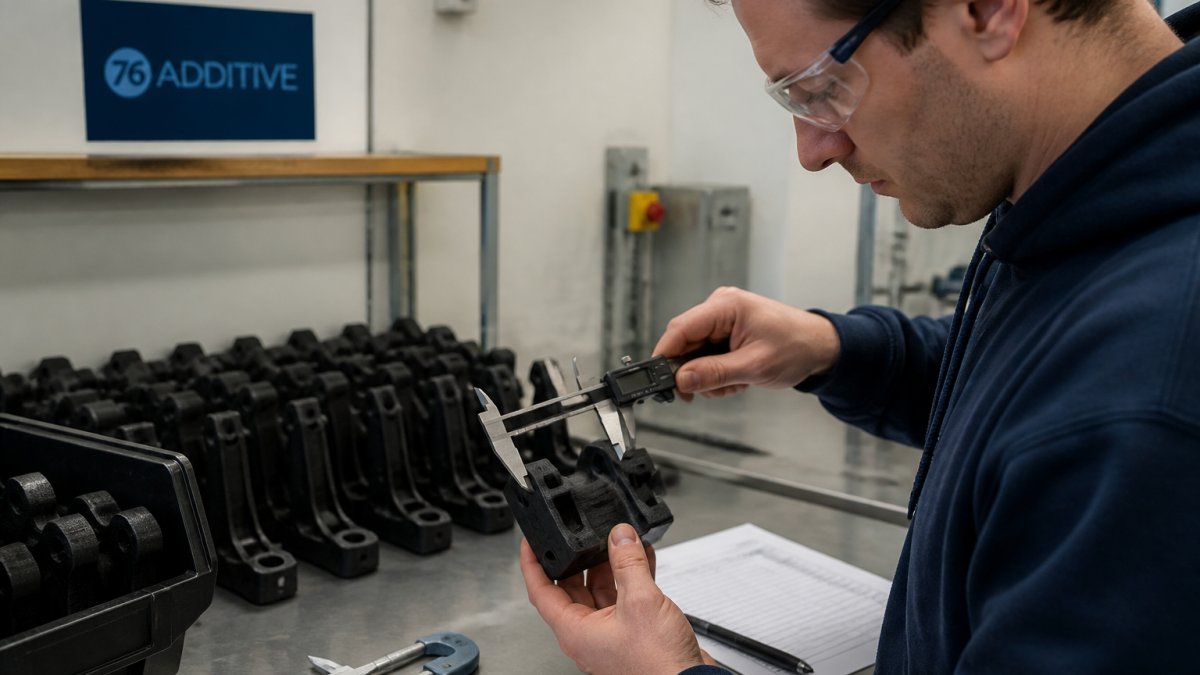
On quality control, the essentials are:
Consistency across batches is the question every buyer asks, and rightly so. Ask any supplier how they prove it. The answer should be records, not assurances.
Choosing a bridge manufacturing partner comes down to three things: can they hit your tolerances, can they prove consistency, and can they scale with you. Everything else is detail.
Here is how we would judge a supplier, and how we would want to be judged:
For firms near Ely and across Cambridgeshire looking for a local bridge manufacturing partner, the practical test is a small trial run. Prove the geometry, then commit.
At 76 ADDITIVE, we have 17 years in design and manufacturing, and we produce components for many UK cycling brands. That background in high-performance, low-volume work is exactly what bridge production demands. You can contact our team to talk through your part.
Bridge manufacturing for automotive parts only works when the design, the process and the quality records all line up. Get those right and you can ship real parts without betting the business on a mould. Get them wrong and the savings vanish in rework.
If you have a part that needs proving before you commit to volume, 76 ADDITIVE can help. Our MJF and Carbon DLS printing needs no tooling investment, our team talks to you directly, and we support you from design review through to repeatable end-use components. Get started with 76 ADDITIVE and take your part from file to finished batch. Request an instant quote through our contact page today.
Bridge manufacturing is the production of end-use parts in the window between prototype sign-off and full mass production. It lets you supply customers, run field trials and build stock while steel tooling is still being cut. For automotive parts, additive processes such as MJF and Carbon DLS are common at this stage because they need no tooling and can be changed between batches. Volumes typically sit in the hundreds to low thousands per run, which is where bridge manufacturing earns its keep.
Yes. Additive manufacturing automotive parts are already used for brackets, housings, clips, ducting and interior components in low and mid volumes. The key is matching the process to the load case: MJF nylon suits structural brackets and enclosures, while Carbon DLS gives finer detail and smoother surfaces for visible parts. Specify the material, wall thickness and build orientation up front, and ask for a small test batch so you can confirm tolerances before committing to a larger run.
Consistency comes from fixing the variables. Lock the material grade, build orientation, nesting and post-processing routine, then keep the same settings for every batch. Ask for dimensional reports against the drawing, material certificates and a first-article inspection on the initial run. For automotive work, agree the acceptance criteria in writing before production starts, and check samples from each batch rather than only the first. A supplier that documents its process is far easier to audit than one that does not.
It often is, because you avoid the upfront tooling spend and the lead time that comes with it. Pricing depends on part size, material, quantity and finishing, so the honest answer is to compare a quote against your tooling cost divided across the expected volume. At 500 to 2,000 units, bridge production usually wins when the design is still evolving or when you need parts in the field quickly. Request a quote with your drawings and volumes to see the real comparison.
Opening Hours (our printers run through the night)
Monday - Friday, 9am - 5pm


76 Additive
19 Hall Barn Road Industrial Estate
Isleham, Ely
Cambridgeshire, CB7 5RJ
76 Projects t/a 76 Additive
Registered in England & Wales Company no: 10235633
VAT: 245 830 796