Oct 11, 2026
Last Updated: October 11, 2026
Additive manufacturing for automotive parts is transforming how companies design and produce components. Instead of expensive tooling and long lead times, manufacturers can now create parts on demand. At 76 ADDITIVE, we work with startups and SMEs across the automotive sector who need speed without sacrificing quality.
The shift from traditional injection moulding to additive manufacturing solves a real problem: high upfront costs. Tooling for conventional manufacturing can cost thousands of pounds and take weeks to produce. With additive manufacturing, you skip that entirely. You design, print, test, and iterate, all in days rather than months.
This approach works particularly well for companies in the early stages. If you're testing a new component design, you need flexibility. Additive manufacturing gives you that. You can modify geometry, test different materials, and validate performance before committing to production volumes.
The technology also enables geometries that traditional manufacturing simply cannot achieve. Complex internal channels, lightweight lattice structures, and integrated features that would require multiple parts in conventional manufacturing become single-piece components. This reduces assembly time and improves reliability.
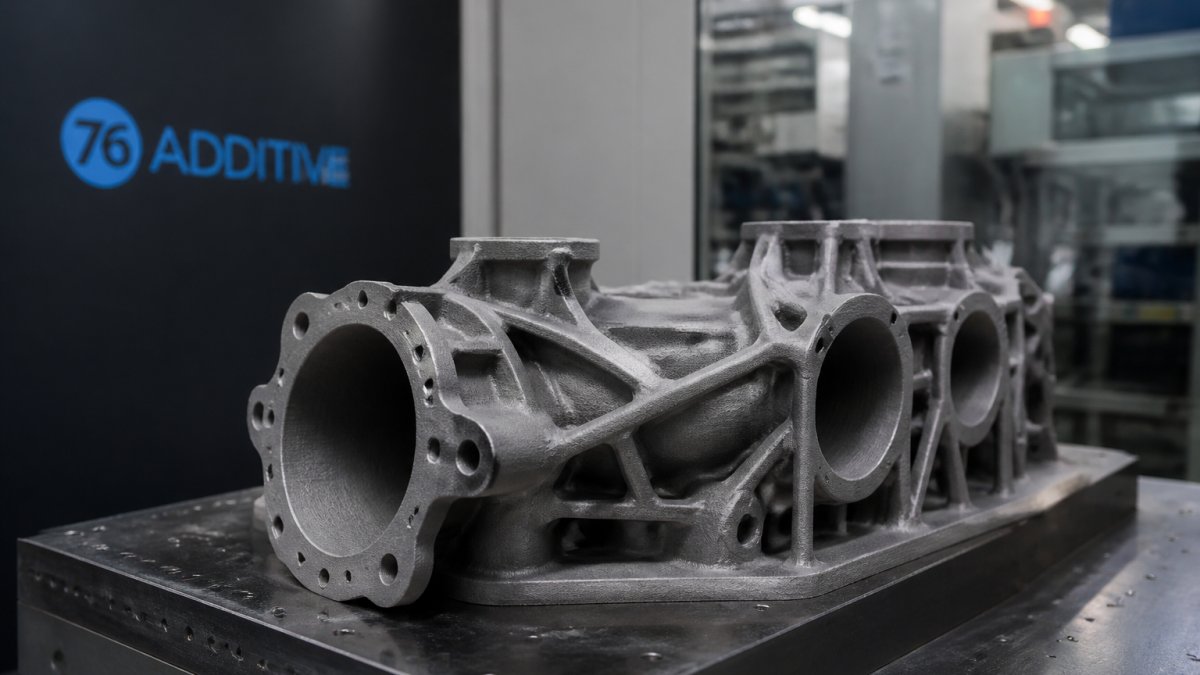
The question most engineers ask first is straightforward: what can actually be printed? The answer depends on your material choice, geometry, and performance requirements. Modern 3D printing technology can produce functional, end-use automotive parts, not just prototypes.
You can manufacture brackets, clips, housings, and structural supports. You can produce complex sensor mounts and cable management systems. Fuel system components, air intake manifolds, and cooling system parts are all viable. The critical factor is matching the material to the application.
What makes this work is precision. Modern additive manufacturing systems hold tolerances that meet automotive standards. Parts come off the printer ready for assembly in many cases. This eliminates secondary finishing steps that traditional manufacturing requires.
One limitation to understand: large, flat, non-structural panels are not ideal for additive manufacturing. If you need a simple flat cover, injection moulding remains more cost-effective at higher volumes. But if your component has geometry that adds value, internal features, integrated mounting points, weight reduction, additive manufacturing becomes the better choice.
The real opportunity lies in low-to-mid-volume production. If you're making 500 to 10,000 units per year, additive manufacturing often beats traditional tooling on both cost and speed. You avoid significant tooling investment entirely.
Material selection determines whether your part performs as intended. The automotive sector demands materials that withstand temperature, vibration, chemical exposure, and mechanical stress. Three material families dominate additive manufacturing for automotive applications.
Nylon is the most widely used material in additive manufacturing. It offers excellent mechanical properties: good tensile strength, impact resistance, and flexibility. Parts printed in nylon can handle vibration without cracking, making them ideal for mounting brackets, clips, and structural supports.
Nylon parts tolerate a wide range of temperatures, suitable for most under-bonnet and interior automotive applications. The material is also chemical-resistant to oils and coolants, which matters for engine compartment components.
One advantage of nylon is cost-effectiveness. It's the most affordable additive manufacturing material, which makes sense for iterative design work. You can print multiple versions, test them, modify the design, and print again without excessive expense.
The drawback is that nylon absorbs moisture. If your part sits in a humid environment for weeks, it will absorb water and swell slightly. For most automotive applications, this is manageable, you can dry the part or apply a protective coating. But it's worth understanding upfront.
For parts that need higher rigidity and temperature resistance, rigid thermoplastics like glass-filled nylon or polycarbonate work better. These materials offer greater stiffness and can handle temperatures up to 100°C or higher, depending on the specific material.
Glass-filled variants are particularly strong. The glass reinforcement increases tensile strength by 30-50% compared to unfilled nylon. This makes them suitable for load-bearing components, structural supports, and parts that experience sustained stress.
The trade-off is cost. Rigid thermoplastics cost more per kilogram than standard nylon. But if your application demands the performance, the investment pays off in reliability and longevity.
Some automotive applications need flexibility. Seals, gaskets, vibration dampeners, and cable management systems benefit from elastomeric materials. Additive manufacturing can produce flexible parts with Shore hardness ratings ranging from very soft to semi-rigid.
Elastomers handle repeated flexing without fatigue failure. They also provide cushioning and vibration isolation, which is valuable for sensitive electronic components mounted in the engine bay.
The challenge with elastomers is precision. They're more difficult to print with tight tolerances, and surface finish can be rougher. But for applications where flexibility matters more than dimensional precision, they're effective.
Designing for additive manufacturing requires a different mindset than traditional design. The technology enables geometries that conventional manufacturing cannot produce, but it also has constraints you need to understand.
Start by removing unnecessary material. Additive manufacturing excels at topology optimisation, creating lattice structures and organic geometries that reduce weight while maintaining strength. A bracket designed for additive manufacturing can weigh significantly less than its injection-moulded equivalent.
Think about orientation. How you position the part on the printer affects strength, surface finish, and print time. Parts oriented vertically print faster but may have weaker layer adhesion in certain directions. Horizontal orientation often produces better mechanical properties but takes longer.
Consider support structures. Additive manufacturing requires temporary supports to hold overhanging geometry in place during printing. Designing parts that minimise support material saves cost and printing time. Sharp internal corners and thin walls need careful attention, they require more support and post-processing.
Surface finish matters for function, not just aesthetics. Printed surfaces have a slight texture from the layer-by-layer process. If your part needs to slide or seal, you may need to specify post-processing like polishing or coating.
Work with your manufacturing partner early. At 76 ADDITIVE, we review designs before printing and suggest optimisations that reduce cost and improve performance. A design review often saves printing time and material waste.
Quality assurance in additive manufacturing follows the same rigour as traditional manufacturing. Your parts must meet performance specifications, dimensional tolerances, and durability standards.
Start with dimensional verification. Measure critical features using coordinate measuring machines or optical scanning. Additive manufacturing can hold tight tolerances, but you need to verify that each batch meets specification.
Mechanical testing validates strength and durability. Tensile testing, impact testing, and fatigue testing confirm that your material and design choices perform as intended. For automotive applications, this is non-negotiable, a component failure in the field creates liability and damages reputation.
Environmental testing checks how parts perform under real-world conditions. Temperature cycling, humidity exposure, chemical immersion, and vibration testing simulate what your component will experience in service. If your part lives in the engine bay, it needs to survive heat cycles and oil exposure.
Functional testing is often the most important. Does the bracket hold the sensor securely? Does the clip grip the cable without slipping? Does the housing seal properly? Real-world performance matters more than laboratory perfection.
Documentation is critical. Keep records of material batch numbers, print parameters, test results, and any modifications. This traceability is essential for automotive supply chain compliance and for troubleshooting if issues arise.
The trajectory is clear: additive manufacturing will continue expanding in automotive applications. As materials improve and printing speeds increase, the economics shift further in favour of additive approaches.
Manufacturers are already moving beyond prototypes. Production-volume additive manufacturing is becoming mainstream for low-to-mid-volume components. Companies that master design for additive manufacturing will have competitive advantages in speed and cost.
New materials are emerging constantly. High-temperature polymers, metal additive manufacturing, and composite materials are expanding what's possible. Within the next few years, we'll see additive manufacturing used for engine components and structural parts that would have seemed impossible five years ago.
The shift also reflects broader industry trends. Automotive manufacturers want flexibility. They want to respond to market changes quickly. They want to reduce inventory and waste. Additive manufacturing enables all of this.
For startups and SMEs, this is an opportunity. You don't need massive capital investment to compete on component quality and speed. With partners like 76 ADDITIVE, you can access production-grade additive manufacturing without owning expensive equipment.
The technology works best when you design with it in mind from the start. Legacy designs optimised for injection moulding often don't translate well to additive manufacturing. But new designs, designs that use the unique capabilities of additive manufacturing, outperform traditional approaches on cost, weight, and complexity.
Additive manufacturing for automotive parts removes the barrier of expensive tooling and long lead times that have constrained innovation for decades. Whether you're prototyping a new component or moving to low-volume production, the technology delivers speed and flexibility that traditional manufacturing cannot match. 76 ADDITIVE specialises in helping automotive startups and SMEs navigate this transition with precision, reliability, and support every step of the way. Our team in Ely, Cambridgeshire, works directly with you to optimise designs, select materials, and deliver parts that meet your exact specifications. Get in touch to discuss your project and see how additive manufacturing can accelerate your product development.
Additive manufacturing works well for brackets, housings, air intake manifolds, custom clips, internal ducts, and low-volume replacement parts. Parts with complex internal geometries—channels, lattice structures, or integrated features—benefit most from 3D printing. The technology suits prototypes, functional test parts, and end-use components for low to mid-volume production runs where traditional tooling costs would be prohibitive.
Additive manufacturing eliminates expensive tooling investment, making it ideal for low-volume runs and rapid iterations. Traditional injection moulding requires significant upfront costs but offers lower per-unit pricing at high volumes. For startups and SMEs, additive manufacturing often proves more cost-effective and faster to market. Design changes are simple and inexpensive with 3D printing; with moulds, they require retooling.
Nylon (PA12) is widely used for functional prototypes and low-volume production due to its strength and durability. Rigid thermoplastics offer excellent mechanical properties for end-use components. Elastomers and flexible materials work for seals, gaskets, and vibration-damping parts. Material selection depends on your part's function, temperature requirements, and mechanical stresses. Professional additive manufacturing services can guide you toward the best material for your specific application.
Rigorous testing protocols, including dimensional verification, tensile testing, and environmental stress testing, confirm part quality. Professional additive manufacturing providers use calibrated equipment and standardised processes to maintain consistency batch to batch. Design validation through small test runs before full production helps identify any issues early. Direct communication with your manufacturing partner ensures quality standards are met and parts perform reliably in the field.
Opening Hours (our printers run through the night)
Monday - Friday, 9am - 5pm


76 Additive
19 Hall Barn Road Industrial Estate
Isleham, Ely
Cambridgeshire, CB7 5RJ
76 Projects t/a 76 Additive
Registered in England & Wales Company no: 10235633
VAT: 245 830 796